I. Concept of Tax Arrears Management
Tax arrears management refers to the systematic activities undertaken by tax authorities with respect to taxes that taxpayers have failed to pay within the time limit prescribed by tax laws and regulations. It covers the identification and prevention of potential arrears before they occur, recovery and control measures after arrears arise, and the write-off and disposal of uncollectible arrears. By establishing a standardized and scientific management system, tax authorities aim to effectively prevent and control tax arrears risks, efficiently recover amounts due, maximize the collection of overdue taxes, while safeguarding the legitimate rights and interests of taxpayers and ensuring fairness in tax collection. Tax arrears management is an integral component of the tax collection and administration system and serves as a critical link between tax filing, tax collection, and tax enforcement. Its compulsory recovery measures themselves constitute an important aspect of tax enforcement. The managed entities include enterprises, self-employed individuals, individuals, and other types of taxpayers that give rise to arrears, as well as related tax matters.
From the Perspective of National/subnational Tax Administration: First, to safeguard fiscal revenue. Through end-to-end control of tax arrears, tax authorities can minimize the loss of tax revenue and promote the full collection of overdue taxes, thereby providing solid fiscal support for public services and social governance. Second, to standardize the tax collection order. By establishing clear rules, processes, and standards for tax arrears management, tax authorities can avoid arbitrary enforcement and ensure fair and equitable treatment of arrears, thereby fostering a market environment that encourages tax compliance and fair competition.
From the perspective of taxpayers: First, to guide tax compliance. Through tiered and categorized reminders, guidance, and interventions, tax authorities can help taxpayers correct unintentional arrears and cultivate awareness of tax compliance. Second, to protect taxpayers’ legitimate rights and interests. By establishing clear rules for handling arrears, flexible payment arrangements (e.g., installment payments), and error tolerance mechanisms, tax authorities can avoid excessive disruption to normal business operations caused by a one-size-fits-all approach and prevent harm to taxpayers’ rights due to over-enforcement. Third, to reduce compliance costs. By providing convenient payment channels and customized solutions, taxpayers can resolve arrears efficiently and at low cost, while minimizing additional costs such as late fees and penalties.
With the development of information technology, the evolution of tax governance concepts, and the enhancement of administrative capacity, tax arrears management has gradually evolved from traditional manual and reactive management to digital and proactive management, and further to intelligent and precision governance.
This foundational stage is characterized by manual operations, reactive recovery, and fragmented processes. Jurisdictions at this stage have a relatively low level of digitalization, limited application of information technology, and a lack of cross-agency data sharing .
Key features: Identification of arrears relies on manual matching of tax filing data and payment records by tax officers, resulting in low efficiency and high error rates. Recovery of arrears primarily involves offline written notices and manual collection efforts, with limited recovery tools (mainly penalties and asset seizure). Disposal of arrears lacks standardized procedures, and write-offs or suspense accounting are based on subjective judgment of tax officers, leading to considerable inconsistency. Cross-agency collaboration is absent; tax authorities cannot access information from banks, market regulators, real estate registries, etc., making it difficult to ascertain taxpayers’ assets and operating conditions. Cross-border arrears management is largely non-existent, with only sporadic manual checks on a few high-value cross-border arrears cases.
Management logic: Centered on "post-event recovery," action is taken only after the occurrence of tax arrears, with no ex-ante prevention or in-process dynamic monitoring. Administrative resources are concentrated on large arrears cases, while small arrears are difficult to recover due to high collection costs, resulting in numerous "blind spots" in collection.
This transitional stage is characterized by data empowerment, proactive monitoring, and standardized processes. Jurisdictions at this stage are featured with primary digital development in tax administration, basic information systems, and limited cross-agency data sharing.
Key features: The tax administration information system can automatically extract and initially screen arrears information, replacing manual verification and significantly improving efficiency. Electronic payment channels and online collection platforms enable automated reminders via SMS, email, and e-tax portals, shifting to a combination of "online + offline" recovery methods. Standardized classification criteria and disposal procedures are established, specifying rules for collection notices, late fees, and installment payments, reducing subjective judgment. Basic data sharing with banks, market regulators, etc., allows inquiries into bank accounts and business registration information, providing data support for recovery of arrears. Cross-border arrears management begins to take shape, with manual exchange of information and coordinated recovery of some cross-border arrears through tax treaties.
Management logic: From "in-process control" toward "ex-ante prevention." Based on automatic identification of arrears, tax authorities proactively and dynamically monitor arrears, conduct timely collection and intervention, and begin to focus on early risk warnings (e.g., advance reminders to taxpayers with abnormal filing). Through standardized procedures, digital tools, and sharing of key data across agencies, administrative costs are reduced, enabling large-scale management of small- and medium-sized arrears cases and preliminary management of cross-border arrears, thereby expanding the coverage of arrears recovery.
This advanced stage is characterized by smart analytics, targeted measures, and ecosystem collaboration. Jurisdictions at this stage are featured with mature digital tax administration, the ability to apply big data and artificial intelligence technologies, comprehensive cross-agency and crossregion data sharing, and robust international tax cooperation.
Key features: Tax authorities use big data, AI, and other technologies to build predictive models for tax arrears risk, integrating multidimensional information such as business data, filing data, asset data, and credit records to achieve early identification of arrears risk and prevent arrears at the source. Risk scoring enables precise classification of arrears behaviors and taxpayers, matched with tailored recovery strategies. Blockchain technology is used for tamperproof evidence of arrears information and payment records, ensuring endtoend traceability. A cross-agency, crossregion data hub for arrears management enables realtime sharing of taxpayer assets, funds, real estate, and other information, facilitating "precision targeting" in recovery. Cross-border arrears management becomes digital and automated, leveraging international tax information exchange mechanisms (e.g., CRS) and global tax cooperation platforms for automatic sharing and coordinated recovery.
Management logic: Centered on "exante prevention and precision recovery," the focus of arrears management is shifted forward. Tax authorities curb arrears at the source through risk prediction and early intervention, while achieving datadriven precision and personalization to balance collection efficiency and taxpayer rights. A multistakeholder ecosystem of "tax authorities + banks + market regulators + judiciary + international tax bodies" is built to achieve comprehensive collaboration in arrears management.
This section provides differentiated guidance for each stage of arrears management, tailored to different levels of administrative capacity, for reference by jurisdictions based on their specific circumstances.
The core objective of this stage is to prevent arrears from occurring at the source, reduce unintentional arrears caused by misinterpretation of policies or omissions in filing, accurately identify potential arrears risks, and intervene early to guide taxpayers toward timely and full payment. Tax authorities primarily use noncoercive means such as policy guidance, filing reminders, and customized assistance.
For tax authorities with basic administrative capacity: Use brochures, policy briefings, inperson guidance at tax service halls, etc., to educate taxpayers on tax laws, statutory obligations, and payment deadlines, focusing on addressing policy misunderstandings and reducing unintentional arrears. Issue periodic filing reminders to reduce arrears caused by missed filings. Implement categorybased management for individuals and enterprises, with focus on large taxpayers. Identify potential arrears risks of large taxpayers through tax audits and public information collection, and conduct direct offline communication to provide early warnings.
For tax authorities with intermediate administrative capacity: Establish online channels such as etax portals, SMS, and email, and use standardized tax documents to achieve automated bulk delivery of filing and payment reminders. Tax publicity includes a dedicated section on arrears management, with systematic and regularly updated information on handling procedures, application requirements for installment payments, and processing steps. Maintain a standardized taxpayer contact database with dynamic updates, and conduct preliminary statistical evaluation and optimization of reach rates, feedback rates, and correction rates for various reminder methods. Deepen taxpayer classification, including highnetworth individuals, large enterprises, those with abnormal filing data, and those experiencing financial difficulties, in the scope of targeted assistance, and provide oneonone customized inperson services to highpriority targets to mitigate arrears risks in advance.
For tax authorities with advanced administrative capacity: Build a predictive model for arrears risk using multidimensional information such as historical payment records, business data, and industry characteristics to automatically identify highrisk taxpayers with a tendency to miss payment deadlines, and provide targeted policy guidance and precision risk warnings based on risk level. Deeply apply behavioral insights technology to personalize reminder content, frequency, and channels based on taxpayer type, risk level, past responses, etc. Promote direct integration between corporate financial systems and tax systems to enable realtime synchronization of transaction data and tax filing data, preventing arrears at the source and shifting arrears management toward proactive prevention.
The core objective of this stage is to initiate recovery procedures promptly after arrears occur, implement differentiated recovery measures based on the amount of arrears, risk level, and solvency of the taxpayer, in accordance with the powers granted by national law, efficiently recover overdue taxes, and create an effective deterrent against willful tax arrears. Tax authorities apply a combination of powers that assist taxpayers in paying, powers to collect overdue taxes, and, when necessary, compulsory powers to enforce payment, following the principle of "noncoercive measures first, compulsory measures as a last resort," and, where appropriate, advocate for the addition of necessary and suitable powers for arrears management under national law.
Typical Examples of Powers Granted to Tax Authorities for Arrears Management in Various Jurisdictions
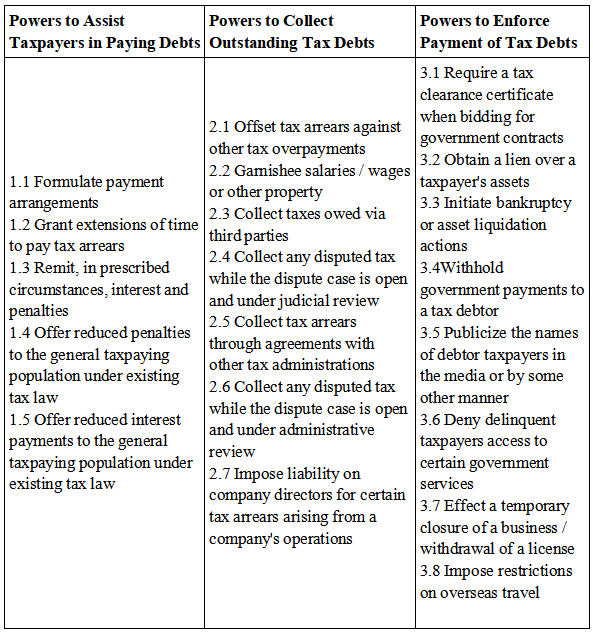
For tax authorities with basic administrative capacity: Issue standardized written collection notices to all taxpayers in arrears while conducting manual offline collection efforts; set tiered thresholds based on the amount of arrears, prioritizing cases exceeding the threshold. For nonlarge arrears, send collection notices using standardized written documents; for large arrears, additionally use bank transfer reminders and onsite asset inspections. Provide offline application channels for installment payments.
For tax authorities with intermediate administrative capacity: Adopt a combination of "online + offline" collection methods, enabling automated delivery of electronic collection notices while retaining written notices and manual offline collection. Implement categorybased management by taxpayer type and arrears amount, differentiating the content and method of collection notices, clearly indicating available payment options (including installment payments), and conducting onsite inspections for large or structurally complex arrears. Offer online application channels for installment payments and streamline approval processes. Gradually establish basic procedural rules for offset operations.
For tax authorities with advanced administrative capacity: Achieve fully personalized collection processes based on a multidimensional risk scoring model, precisely subclassifying taxpayers and matching optimal communication channels, customizing collection content, and dynamically adjusting communication strategies using behavioral insights. Establish crossagency data sharing channels for realtime monitoring of fund flows, asset changes, etc., and routinely use data analytics to identify highrisk arrears situations. Implement graduated enforcement procedures, taking legally mandated compulsory measures such as account freezes, fund withholding, asset seizure, and auction/sale of assets. Enable automated approval of installment payment applications, intelligently generating payment plans based on taxpayer asset status. Automate offset operations and collaborate with other government agencies on crossagency offsets to ensure efficiency and compliance.
The core objective of this stage is to implement standardized registration, suspension (suspense accounting), and writeoff of uncollectible arrears, continuously track and identify recoverable leads, and promptly resume recovery efforts. Multidimensional credit constraints and coordinated supervision strengthen followup management, preventing the resurgence of arrears risk and achieving full lifecycle control of arrears. It is important to note that at this stage, the tax authorities’ legal right to collect the taxes does not expire; if new recoverable assets are discovered, the authorities may still use the powers listed in the recovery stage.
For tax authorities with basic administrative capacity: For arrears manually determined to be uncollectible, complete registration and suspense accounting by the responsible officer, and conduct periodic manual reviews. Establish basic standards for writeoff, initiating writeoff procedures only for arrears that have exceeded the statute of limitations for collection, following standardized manual writeoff procedures. Apply penalties as fixed amounts or percentages, develop uniform enforcement standards, and specify procedures and document preparation. Rely on officers’ personal experience to determine when to terminate recovery efforts.
For tax authorities with intermediate administrative capacity: Establish an arrears management information system to electronically record suspense accounting and writeoff of uncollectible arrears. Digitize the approval process for writeoffs and suspense accounting, define approval authority and time limits at each stage, and ensure traceability and query capability. Use semiautomated analytical tools to conduct risk reviews of uncollectible arrears, assessing recoverability based on factors such as arrears characteristics, taxpayer status, historical collection records, and opportunity costs. Establish core writeoff criteria based on aging of arrears and whether the taxpayer is untraceable, supplemented by multifactor data analysis to optimize the assessment of recovery probability as a basis for writeoff decisions. Establish an error tolerance mechanism to reduce or waive penalties for unintentional arrears. Establish a lead response mechanism to immediately resume recovery efforts upon obtaining information about new assets or the taxpayer’s whereabouts.
For tax authorities with advanced administrative capacity: Leverage big data and AI to achieve automated approval of writeoffs and suspense accounting, with preset multidimensional indicators. Build a dynamic monitoring platform for arrears that enables realtime monitoring of suspended or writtenoff arrears, automatically updating status, recovery progress, etc., with a fully traceable endtoend record. Integrate internal and external multisource data to conduct continuous tracking and analysis of uncollectible arrears, capturing in real time leads such as asset changes, business recovery, or the taxpayer’s location. Upon detecting previously unknown assets or traceable information, automatically flag the case and initiate recovery procedures, enabling dynamic and targeted recovery. Use predictive modeling and AI to intelligently assess recoverability and automatically generate recommendations to continue or terminate recovery. Establish a deep linkage between arrears behavior and the tax credit system, coordinating with development and reform commissions, financial regulators, market regulators, etc., to impose joint constraints on access to tax incentives, tax compliance facilitation, financing credit, market access, etc., creating a framework of "once in arrears, restricted everywhere". Establish crossborder cooperation mechanisms for the disposal of arrears with international tax bodies, promote automation of crossborder tax information sharing, jointly assess the recoverability of crossborder arrears, and coordinate recovery measures to enhance the efficiency of crossborder arrears disposal.
【Cases in Tax Arrears Management】
【China】ScenarioBased Empowerment for Tax Arrears Governance, Refined Protection of Tax Revenue
To address the challenges of tax arrears arising from a diversified market economy and overcome the shortcomings of traditional, undifferentiated management, China has innovatively introduced a scenariobased model for tax arrears management. Guided by the principles of "differentiated strategies, precision governance, balance of rigidity and flexibility, and collaborative cogovernance," and leveraging tax big data, China has developed a solvency assessment model for taxpayers in arrears, focusing on their funds, assets, tax refunds, and business operations. Using multidimensional indicators and scenariobased combinations, taxpayers are divided into seven basic scenarios under two broad categories: "solvent" and "insolvent." Arrears management measures are precisely matched to these seven scenarios, enabling differentiated enforcement. Since the implementation of the scenariobased management model, multiple objectives have been achieved: overall arrears remain under control, collection efficiency has significantly improved, the business environment has been continuously optimized, and taxpayer compliance has notably increased, effectively enhancing the efficacy of tax arrears governance and advancing it to a new level.
【The United Arab Emirates】 A Comprehensive, RiskBased Framework for Tax Arrears Management
The United Arab Emirates, through its Federal Tax Authority (FTA), has implemented a comprehensive, risk-based framework for managing tax debt and safeguarding tax collection. The system is structured around preventive measures, corrective actions, and enforcement escalation.
On the preventive and early intervention side, the FTA emphasizes early risk detection and voluntary compliance. This is achieved through compliance scoring and real-time monitoring of filing and payment activities, as well as automated pre-due reminders sent via SMS, email, and dashboard alerts to prompt timely settlement. The FTA also integrates with licensing authorities and other government entities to monitor taxpayer behavior and enforce administrative restrictions where necessary.
The structured debt management framework classifies tax debts based on value, aging, legal status, and estimated recovery probability. This classification feeds into a clear escalation matrix that includes a soft reminder phase with notifications and outreach, followed by operational escalation involving direct calls, emails, and field visits. Subsequent steps include administrative measures such as temporary restrictions on certain government services, legal escalation through the issuance of administrative execution decisions, and finally judicial execution via referral to courts and enforcement authorities.
Cross-government integration plays a critical role in enforcement. The FTA exchanges data with key national entities, including licensing authorities, federal and local courts, the Central Bank, and the Ministry of Human Resources. This enables coordinated enforcement actions such as asset seizure, fund transfers via GIBAN mechanisms, and suspension of commercial services for non-compliant taxpayers.
Finally, the FTA maintains performance dashboards and key performance indicators, such as collection rates, aging buckets, and recovery rates, which are monitored at the executive level. A clearly defined Standard Operating Procedure governs debt management, ensuring efficient resource allocation, fair taxpayer treatment, and alignment with international best practices including TADAT and OECD.
【Hungary】Management of Tax Debts Deemed Irrecoverable--Realistic Considerations in Debt Recovery
Identifying economically non-recoverable claims and writing off debt is also an important element of efficiency. Hungarian legislation provides clear rules both for an optimal limitation period (the limitation period for enforcement is 4 years, which is extended by six months if an enforcement action is carried out) and for the periodic (annual) review of debts classified as affected by temporarily unsuccessful enforcement. The regulation thus enables the enforcement field to focus on debts that are close to their due date and proportionate in amount to the administrative costs of enforcement actions.
Pursuant to Sections 20–21 of Act CLIII of 2017 on enforcement proceedings carried out by the tax authority, if the taxpayer and - where a payment obligation is imposed - the person obliged to pay the tax have no enforceable assets, the tax authority conducting the enforcement procedure may classify the taxpayer’s debt, as well as debt owed to the State arising from a state guarantee, as a debt affected by temporarily unsuccessful enforcement without issuing a formal decision, and may keep it on record under this legal title until the debt becomes enforceable or until the right to enforcement lapses.
A debt may also be recorded as affected by temporarily unsuccessful enforcement if a portion of the debt is not recovered during the enforcement procedure. In the case of a debt classified as affected by temporarily unsuccessful enforcement, for one year from the last enforcement action, the NTCA shall treat any new debt of the taxpayer in the same way, unless data in the NTCA’s records or otherwise available to it indicate that the taxpayer has assets or income that can be subjected to enforcement.
The NTCA shall review, on an annual basis, the debts recorded as affected by temporarily unsuccessful enforcement in order to determine whether these debts have become enforceable. In the absence of enforceable assets or income, the NTCA will continue to treat the taxpayer’s debt as affected by temporarily unsuccessful enforcement for one year from the date of the review. The NTCA shall reclassify the debt recorded as affected by temporarily unsuccessful enforcement as enforceable if, within the limitation period of the right to enforcement, the debt becomes enforceable.
In the case of claims exceeding 10,000 forints but not exceeding 200,000 forints, the state tax and customs authority conducting the enforcement procedure shall - with the exception of claims arising from the European Union’s traditional own resources, asset confiscation expressed as a monetary amount, and fines imposed on legal persons in criminal proceedings - enforce collection exclusively through an official transfer order and income garnishment. If these prove unsuccessful, the authority may - without issuing a formal decision - classify the debt as affected by temporarily unsuccessful enforcement and keep it on record under this legal title until it becomes enforceable or until the right to enforcement lapses.
In the case of a taxpayer who cannot be subjected to liquidation proceedings, the classification of the debt as affected by temporarily unsuccessful enforcement is the primary responsibility of the directorates.
【Greece】Penalties and Enforcement Measures Against Tax Debtors
The Greek Tax Administration (TA) proceeds to seizure of movable property, immovable property, and assets held by third parties (salaries, pensions, bank accounts etc.), auction of movable and immovable property and mortgage (law 4978/2022, 5104/2024, Civil law).
Moreover, According to Greek legislation (Tax administration law), taxpayers who fail to pay to the State their overdue debts over 100.000€ including interest or surcharges for a period over 4 months, are facing criminal charges of imprisonment for at least one (1) year and up to five (5) years. Tax payers who fail to pay to the State overdue debts over 200.000€ including interest or surcharges for period over 4 months, are facing criminal charges of imprisonment for at least three (3) years and up to five (5) years ( art. 25 law 1882/1990).
Furthermore (TA) has a list disclosing tax debtors whether natural persons or legal entities. This list is published once per year on the internet by the TA and is available to the public. To be included on the latter list, one must have accrued a tax, custom or social contribution debt of above €150,000 (Greek law 3943/2011)
With the continued advancement of global digital transformation, deepening international tax cooperation, and ongoing evolution of tax governance concepts, tax arrears management will move toward greater intelligence, internationalization, integration of supervision and services, and multistakeholder cogovernance, becoming an integral part of the global tax governance system.
Using big data, artificial intelligence, blockchain, and other technologies as key drivers, build accurate predictive models for tax arrears risk to achieve realtime risk anticipation and source prevention. Deploy intelligent technologies across collection, approval, writeoff, and other processes to enhance efficiency and reduce costs. Break down crossagency data silos to achieve seamless data sharing among tax authorities, banks, market regulators, and other institutions, creating a comprehensive taxpayer view to support precise recovery and crossdomain joint prevention and control.
The deepening integration of the global economy makes crossborder tax arrears a shared challenge for global tax governance. The international dimension of tax arrears management will become more prominent. On the one hand, the international tax framework centered on the OECD, G20, CRS, and others will continue to improve, promoting the establishment of unified standards and procedures for crossborder arrears management across jurisdictions and enabling automatic, realtime sharing of crossborder arrears information. On the other hand, jurisdictions will strengthen cooperation in crossborder arrears recovery, establish regular mechanisms for crossborder collection, achieve precise control over crossborder taxpayers, and reduce international collection gaps. At the same time, efforts are gradually being explored to establish a crossborder credit linkage mechanism for arrears, linking crossborder arrears behavior to the international credit rating of taxpayers and using global credit constraints to promote crossborder tax compliance.
Shift from a "regulationcentered" to a "taxpayercentered" approach. Build intelligent online service platforms that provide customized payment solutions and policy guidance for taxpayers based on the specific causes and circumstances of their arrears. Improve error tolerance mechanisms and dispute resolution mechanisms, balancing enforcement rigor with service flexibility. Deepen the integration of tax credit systems with broader social credit systems, establishing a "reward for compliance, punishment for noncompliance" mechanism. Use credit constraints to increase the cost of arrears while providing convenient services and preferential policies for compliant taxpayers, thereby building a longterm foundation for tax compliance.